
RESONANCE
The Wind That Kills the Giant: Resonance and Bridge Collapse — A Technical Analysis

Resonance is a physical phenomenon that can cause the catastrophic failure of structures, including bridges, when the external excitation frequency matches the natural frequency of vibration of the structure. This phenomenon is critical in civil engineering to ensure structural stability under dynamic loads.
The Basic Concept: When Rhythm Is Everything
To understand resonance, imagine a swing: if you push a person at a constant rhythm, synchronized with its natural motion (natural frequency), each push adds energy, increasing the amplitude of the movement. Eventually, the swing could reach extreme heights or even topple over.
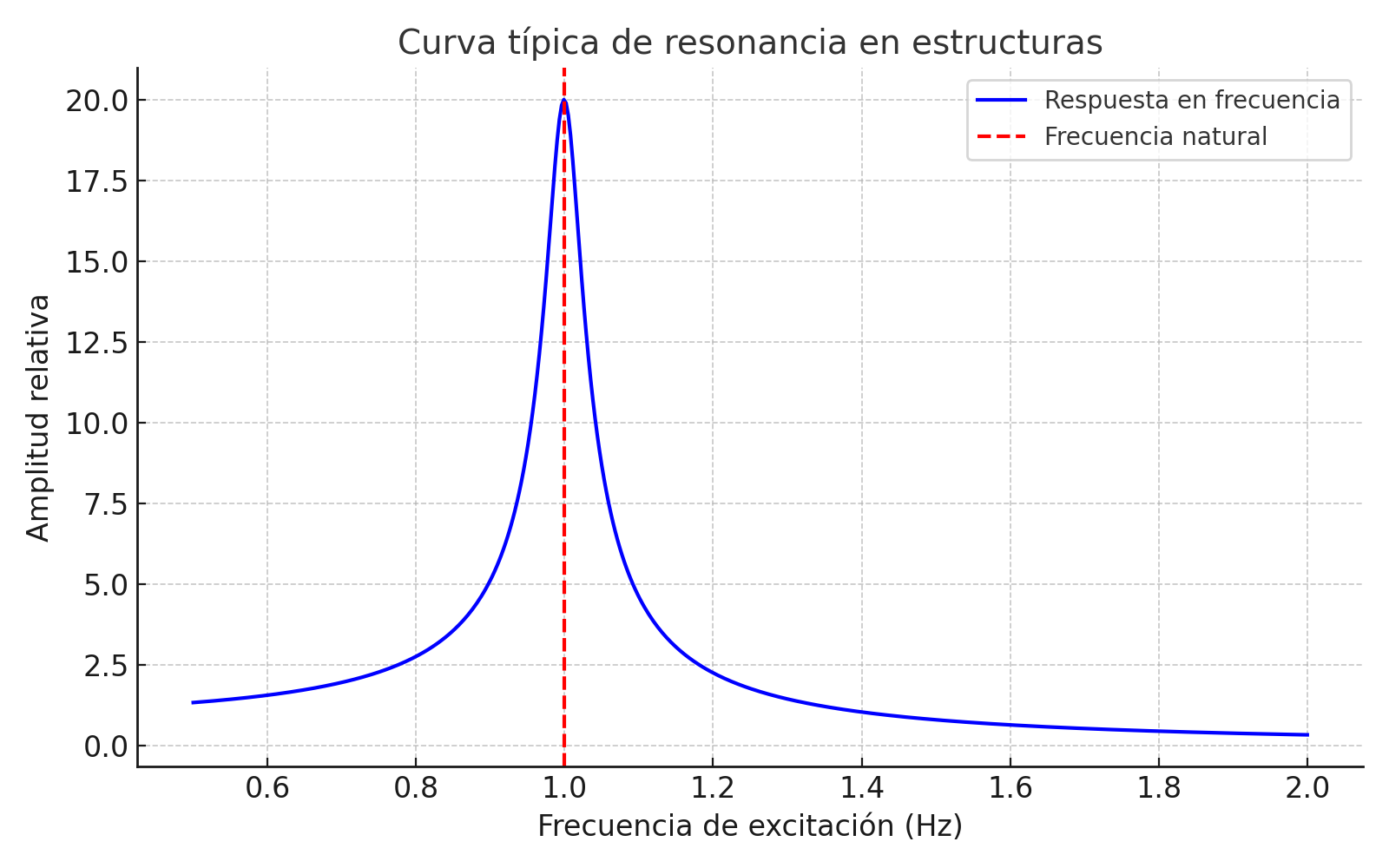
In essence, resonance is this: an external force acting on an object at a frequency that matches its natural frequency of vibration. When this happens, the amplitude of the vibrations increases dramatically, often to the point of structural failure.
A Deeper Look: The Aerodynamics of Disaster
In the case of the Tacoma Narrows Bridge, the phenomenon was more complex than a simple rhythmic push. It was an aeroelastic flutter, a bidirectional interaction between the wind and the structure:
Wind induced a torsional motion.
The torsion altered the wind flow around the structure.
The altered flow generated more torsion, further amplifying the motion.
This positive feedback loop drove vibrations to a point where stresses exceeded the material capacity, leading to collapse.
Fundamentals of Resonance
From a mechanical perspective, every structure has one or more natural frequencies.
If a periodic external force (wind, traffic, seismic vibration) acts at that same frequency, the oscillation amplitude can increase significantly.
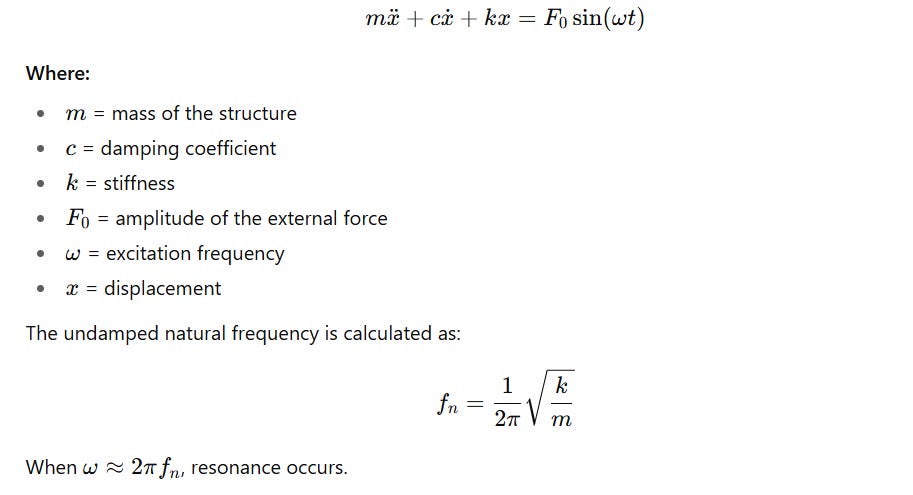
This behavior can be modeled as a forced harmonic oscillator:
Historical Case: Tacoma Narrows (1940)
Length: 1,810 m
Height above water: 55 m
Wind speed at collapse: ~67 km/h
The aerodynamic profile of the deck generated vortex shedding at a frequency matching the bridge’s torsional frequency, triggering aeroelastic flutter.
In this phenomenon, wind–structure interaction amplified vibrations until total structural failure occurred.
Spanish Example: Alconétar Arches Bridge (2006)
During the lifting of one of its large steel arches, winds of 20–30 km/h matched the arch’s natural frequency.
This generated visible vibrations that were quickly mitigated using temporary bracing and adjustments to the erection procedure.
This case shows that resonance is not only a risk in the final structure but also during temporary construction phases.
Modern Engineering Prevention Strategies
Wind tunnel testing to study aerodynamic interaction.
Increased damping using energy dissipation devices.
Optimized aerodynamic profiles to reduce vortex formation.
Adjusting stiffness and mass to shift the natural frequency out of critical ranges.


Conclusion
Resonance is a quantifiable and predictable phenomenon that requires precise modal analysis, dynamic simulations, and exhaustive aerodynamic verification.
Understanding and anticipating this behavior is essential to ensure that modern bridges withstand not only gravity but also the subtle yet potentially destructive dynamic forces of the wind.